Operational Data Store (ODS) using SAP BW 3.5
ODS consists of 'Key fields' and 'Data fields'. Data fields can also contain characteristics e.g. customer, product etc..
ODS is not used for multi-dimensional analysis like Infocube. The data from ODS can be updated with delta update into a Infocube. The data in ODS is stored in a transparent table. There is no fact or dimensional table created for ODS.
Following are the steps to create an ODS:
1) Execute transaction RSA1, select the InfoArea under which you would like to create ODS. Right click the InfoArea, select 'Create ODS Object'
 2) Enter ODS Object 'Name' and 'Description', press 'Create'
 3) Check the box against 'BEx Reporting' to enable ODS for BEx reporting, press 'InfoObject Catalog' button to get the InfoObjects which you would like to add to ODS
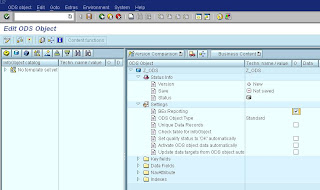
4) Select the characteristics (InfoObjects) which you would like to add as 'Key fields' or 'Data fields', drag and drop the InfoObjects in respective folders as shown below.
 5) You can also insert an InfoObject into to fields folders by right clicking the folder
 6) Add '0CALMONTH' as 'Key field'
 7) Add Key Figures as 'Data fields' as shown below, check and activate the ODS, system will display message related to ODS activation

8) Press 'Back', you can see ODS as shown
 Now define InfoSources, Transfer Rules, Update Rules, Info Package as discussed in Infocube Creation Steps.
ODS is not used for multi-dimensional analysis like Infocube. The data from ODS can be updated with delta update into a Infocube. The data in ODS is stored in a transparent table. There is no fact or dimensional table created for ODS.
Following are the steps to create an ODS:
1) Execute transaction RSA1, select the InfoArea under which you would like to create ODS. Right click the InfoArea, select 'Create ODS Object'
 2) Enter ODS Object 'Name' and 'Description', press 'Create'
 3) Check the box against 'BEx Reporting' to enable ODS for BEx reporting, press 'InfoObject Catalog' button to get the InfoObjects which you would like to add to ODS
4) Select the characteristics (InfoObjects) which you would like to add as 'Key fields' or 'Data fields', drag and drop the InfoObjects in respective folders as shown below.
 5) You can also insert an InfoObject into to fields folders by right clicking the folder
 6) Add '0CALMONTH' as 'Key field'
 7) Add Key Figures as 'Data fields' as shown below, check and activate the ODS, system will display message related to ODS activation
8) Press 'Back', you can see ODS as shown
 Now define InfoSources, Transfer Rules, Update Rules, Info Package as discussed in Infocube Creation Steps.
9) Below is the Extraction Structure created based on ODS


Comments
From an SAP student.